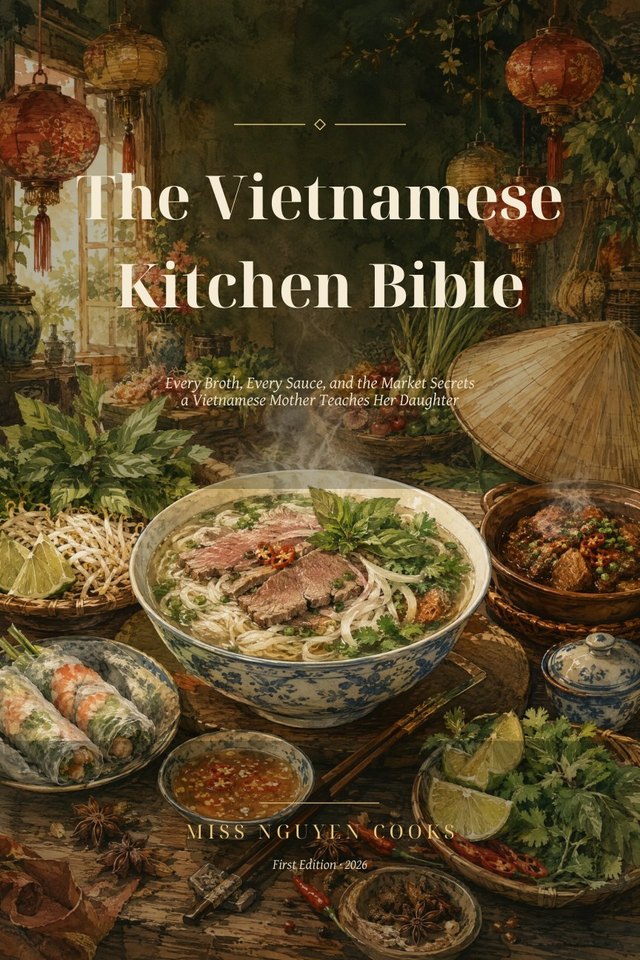
Ask a Vietnamese mother how much fish sauce goes in and she tips the bottle and says like this. This book is the part she could not put into words — the handful of moves every dish is built from: why a broth stays clear, how the four tastes get balanced and in what order, and how to fix a dish that tastes wrong.
Instant download · Yours forever
“A recipe teaches you one dish. A method teaches you fifty.”
Miss NguyenMy mother cooked for six people, twice a day, for thirty years, and she never once measured anything. When I asked how she knew a broth was ready she would taste it and say it is sweet now — and I would taste the same broth and not know what she meant.
She was not withholding anything. She had learned by standing next to her own mother in a kitchen in Can Tho for fifteen years, and nobody had ever needed the words from her. That kind of teaching does not fit into a book. The Vietnamese Kitchen Bible is my attempt anyway.
How a broth is made and why it stays clear. How a dipping sauce is built. How a braise is darkened. How the herbs, the crunch and the sour thing at the edge of the plate are not decoration — they are structure. Learn those and you will not need a recipe for most of what you want to cook.
I have tried to be honest about the hard parts. Some dishes take two days and some ingredients cannot be substituted, and I say so. Every chapter ends with a short section called The Limits — what the method will not do, where it fails, and when the honest answer is to cook something else.
The Vietnamese Kitchen Bible · First Edition · 2026
144 illustrated pages · 7 parts · 5 appendices
It is almost never the recipe. It is the handful of steps a recipe leaves out, because the person who wrote it learned them too young to remember they were steps at all.
Every chapter has the same shape: what the thing is and why it matters, then the method walked through the way one cook walks another through it at her elbow, then The Limits — where it goes wrong, what it costs, and when to do something else.
Chapter 86 — What I Would Cook First. The eight weeks I would give a friend starting from nothing. Week one is do chua, nuoc cham, properly cooked rice and one stir-fried green — a full meal that costs almost nothing. Week eight is beef pho on a Saturday.
Instant download · Yours forever
“Chapter 24 alone. My pho has tasted like hot water for ten years. It was the parboil and the boiling. That was it. My husband asked which restaurant I ordered from.”
“My grandmother was from Saigon and never wrote anything down. Reading this was like hearing her in the kitchen again — the caramel, the herbs by the handful, the tasting and fixing. I cried a little over the Last Word.”
“I printed the Master Ratio Card and taped it inside the cupboard door. I have not looked up a nuoc cham recipe since. We eat Vietnamese twice a week now, from an ordinary supermarket.”
I learned to cook the way my mother did — not from a page, but from standing beside her. She learned the same way, at her own mother's elbow in a kitchen in Can Tho. Nobody in our family ever wrote a recipe down, because nobody ever needed to.
When my mother got old, I finally started writing things down. I would stand in her kitchen with a notebook and she would get impatient with me. You taste it, and if it is not right you fix it — as though that settled the matter. She was right, of course. Everything in this book collapses into that sentence.
I have been teaching this food for years now, and the same handful of mistakes account for most of the disappointment. Not enough herbs. Cheap fish sauce. Boiling the broth. Being afraid of the caramel. This book is where I fix them for you, in order.
Cook the food. Feed people with it. Get some of it wrong. Adjust it the next time. And keep herbs in the house — always more than you think you need.
Every Broth, Every Sauce, and the Market Secrets · First Edition
Launch promo · ends at midnight
Get The Vietnamese Kitchen Bible — $47 $27Instant download · Yours forever
It is home cooking — the way it was taught to me, the way my mother was taught in Can Tho. It covers the family table as much as the famous dishes: canh, the everyday soup; rice cooked properly; the braises that taste like home; how a family meal is actually assembled.
Vietnam is not one kitchen, and I say where the north, the center and the south do things differently. Where a dish is hard, I say so. Beef pho takes six hours and I will not pretend otherwise.
The videos are one dish at a time, in whatever order I filmed them. The book is the whole method in order — pantry, balance, broth, table, street food, pickles, sweets — with the reasoning written underneath each step, the part that never fits in a video.
It is also the part you can keep open on the counter: the ratio card, the broth timings and the substitution table in one place instead of scattered across a hundred videos. Keep watching. The book is for when you want the whole thing.
Chapter 86, What I Would Cook First. It lays out eight weeks in order, starting with do chua, nuoc cham, properly cooked rice and one stir-fried green — a full meal for almost nothing — and ending with beef pho on a Saturday. Do not try to cook everything in one weekend. Pick the dish you most want to eat, cook it, eat it, then pick another.
Yes. Chapter 83 is Making Vietnamese Food Without a Vietnamese Market, and Appendix D is a substitution table for when your store does not carry something. Where an ingredient has no honest substitute, I name it rather than fudging. The six tools that do everything are in Chapter 13, and you probably own most of them already.
There is a chapter for exactly that — Chapter 84. Most people who say it have only met cheap fish sauce, used badly. Chapter 2 shows you how to read the bottle.
Because it is a file and not a printed book, and because I would rather it be in a thousand kitchens than on ten shelves. $47 is what it will sell for once the launch promo ends. Until then it is $27 — less than a pho dinner for two.
One illustrated PDF, 144 pages, delivered by email the moment you order. It reads on a phone, a tablet or a computer. The five appendix sheets are laid out to be printed and kept beside the stove. Measurements are in American cups, tablespoons and pounds, with ratios wherever a ratio is more useful. It is yours to keep.

Eighty-six chapters, every broth and every sauce, the Master Ratio Card and the eight-week starting plan — $27 until the launch promo ends at midnight. After that it is $47.
Get The Vietnamese Kitchen Bible — $47 $27 or see what's inside →